There are three main materials I’d consider when choosing a decking substructure:
- Timber
- Recycled plastic
- Aluminium
They all have their place.
The mistake is assuming that one material is automatically the best for every deck.
The right choice depends on where the deck is being built, how high it is, the expected lifespan, the type of decking being installed and, of course, the budget.
So let’s look at each option properly.
1. Timber — the traditional choice
Timber is still the most common material used for decking subframes, and when it is specified and installed correctly, it can be an excellent option.
But here’s the important question:
Is all treated timber the same?
Absolutely not.
Two pieces of timber can look almost identical but have very different levels of protection and structural performance.
One of the biggest things people overlook is the Use Class (UC) of the timber.
UC2 vs UC4 — what’s the difference?
UC2 is intended primarily for internal applications where the timber is protected from the weather but may occasionally experience moisture.
UC4 is designed for much more demanding outdoor applications where the timber is exposed to significant moisture and biological hazards, including situations involving ground contact.
That’s a pretty important difference when you’re building a deck.
And yet, the treatment specification is something many homeowners would never think to ask about.
So what should you be looking for?
For an external decking subframe, I personally prefer UC4 treated structural timber, rather than simply accepting whatever treated timber happens to be available.
For my own builds, my go-to timber is:
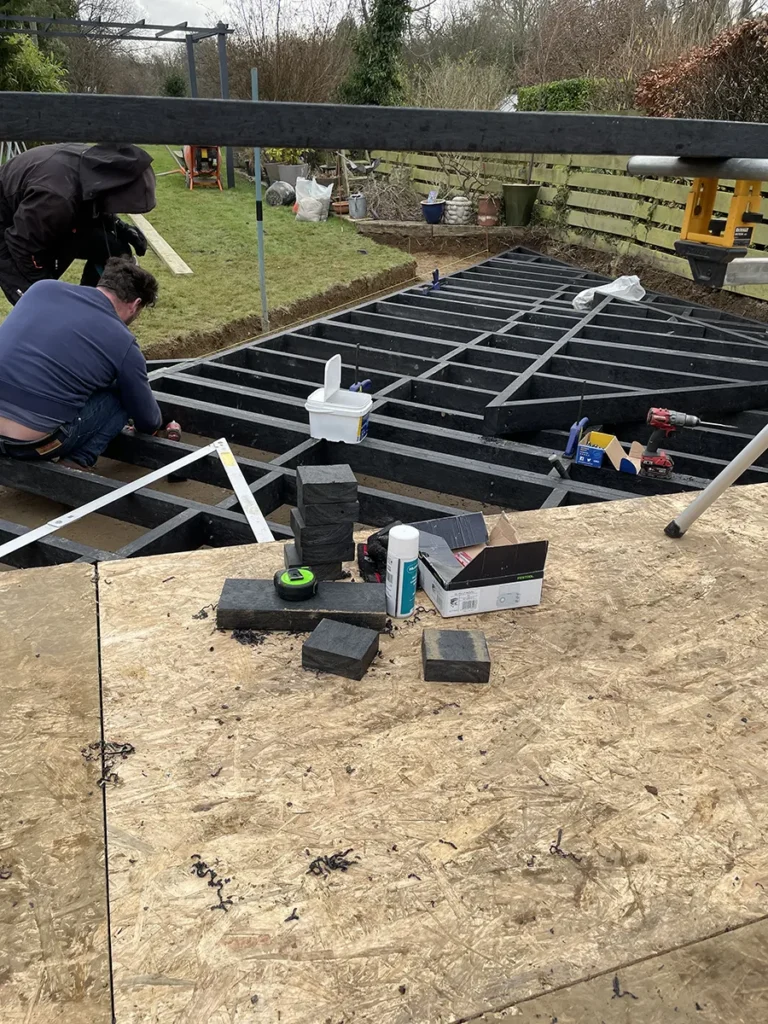
UC4 treated C24 structural timber, normally 6” x 2”.
C24 is a higher structural strength class than C16, giving you a stronger structural timber option.
A 6” x 2” section also gives you a substantial joist compared with lighter timber sections.
There are situations where a 4” x 2” section may be appropriate, particularly where height is restricted, but I would generally prefer the larger section where the design allows it.
What happens when you cut treated timber?
This is another area that gets overlooked.
When you cut treated timber, the freshly exposed end isn’t protected in exactly the same way as the factory-treated timber surrounding it.
That’s why I treat cut ends with a suitable end-grain preservative.
It’s a small job, but it’s another layer of protection against moisture getting into the timber through the cut end.
And if you’re spending money on good-quality treated structural timber, it makes little sense to ignore the exposed ends.
The fixings matter too
A strong timber frame is only as good as the connections holding it together.
I wouldn’t recommend buying a box of generic wood screws and assuming they’ll do the job.
A decking subframe needs to support the decking, people, furniture and the loads transferred through the structure.
That’s why I use structurally suitable external fixings designed for the job.
For example, I personally use Carpenter Mate Pro structural screws, including longer fixings for joining joists and ring beams and shorter fixings for components such as noggins.
The exact fixing specification should always be appropriate for the particular structural connection.
Don’t forget the top of the joists
Another relatively simple upgrade I recommend is joist protection tape.
The tops of your joists are one of the areas most exposed to trapped moisture.
Water can sit around the decking boards, debris can accumulate and moisture can find its way around fixing points.
A good-quality decking tape creates a barrier over the top of the joist and around the fixing penetrations.
It isn’t going to magically make a poor-quality frame last forever, but it’s another sensible precaution when you’re trying to maximise the life of the structure.
What about the posts?
This is where I start looking at alternatives to timber.
For many of my lower-level decks, I prefer recycled plastic posts.
Why?
Because I’ve seen what can happen to timber posts over time.
A timber post sitting in or very close to the ground is exposed to some of the harshest conditions a timber structure can experience.
If you’re building a deck that you expect to last for decades, I don’t want the weakest part of the structure hidden underneath the ground.
However, recycled plastic posts aren’t suitable for every situation.
There are limitations to how high they can be used, particularly because of movement and structural requirements.
Once you’re getting into significantly raised structures, I’d start looking at alternatives such as appropriately designed timber posts with suitable protection, steel or aluminium systems, concrete solutions, ground screws or other engineered support systems.
The correct choice depends on the structure and the loads involved.
Don’t forget the deck board manufacturer’s requirements
This is another really important point.
Every decking system has its own installation requirements.
Joist spacing, support spacing, fixing methods and allowable spans can vary between products.
Don’t design the subframe first and then simply assume every decking board can go on top of it.
The board manufacturer’s installation instructions should form part of the design.
And on raised decks, you may also need to consider a beam-and-joist system rather than simply running joists between individual supports.
The beams allow the loads to be distributed through the structure and can make a much more efficient raised-deck design.
When wouldn’t I choose timber?
There are certain situations where I would seriously consider another material.
Below-ground applications
This is where I become much less enthusiastic about relying on timber.
Even well-treated timber is still timber.
It needs the right conditions and detailing to remain durable.
If I can remove timber from a high-moisture or below-ground environment altogether, that’s something I’d seriously consider.
Rooftop decks and balconies
Weight can become a major consideration on rooftops and balconies.
This is where aluminium can become particularly attractive because of its combination of low weight, dimensional stability and durability.
2. Recycled plastic
Recycled plastic is a completely different proposition.
Products such as Millboard’s Plas-Pro are designed for situations where resistance to moisture and decay is extremely important.
And that’s the big advantage:
It doesn’t rot like timber.
For certain below-ground applications, that’s a huge benefit.
But there’s another side to recycled plastic that isn’t always talked about.
It’s difficult to work with.
In my experience, constructing a perfectly straight, level and accurately dimensioned frame from recycled plastic can take considerably longer than constructing the same frame from timber.
The material can be difficult to manipulate, and fixing it requires more thought.
You may need to pre-drill components, countersink fixings and deal with the fact that screws don’t behave in recycled plastic in quite the same way they do in solid timber.
Some recycled plastic sections can also be less uniform and more difficult to get perfectly straight.
And because the material can move with temperature, you also need to take thermal movement into consideration.
All of this adds up.
So is recycled plastic bad?
No.
Far from it.
It has a very specific purpose, and when that purpose suits the project, it can be an excellent material.
But I wouldn’t automatically choose it for an entire deck simply because it won’t rot.
For many projects, I’d rather put the money towards the third option.
3. Aluminium — the premium option
This is where things get interesting.
For me, aluminium is the future of decking substructures.
It’s lightweight, extremely durable and doesn’t suffer from the same rot problems as timber.
You don’t have to worry about treating cut ends.
You don’t have to worry about bowed timber joists.
You don’t need to cover every joist with protection tape.
And you don’t have the same problems with screws relying on timber to hold their threads.
It also makes an extremely clean and accurate frame.
The downside?
Cost.
There’s no point pretending aluminium is cheap.
The material cost can be significantly higher than timber.
But there’s another side to the calculation:
Installation time.
A system that is faster and easier to install can reduce labour time.
So while aluminium costs more to buy, the overall difference in project cost isn’t necessarily as dramatic as the material price alone suggests.
And you’re also investing in a substructure that should significantly outlast a conventional timber frame.
Millboard DuoSpan
One aluminium option is Millboard DuoSpan, which was designed specifically around the Millboard decking system.
It’s a very neat system and can make installation considerably easier.
There is one limitation, though.
When using certain Millboard fixing methods, you still need a suitable material within the aluminium profile for the decking fixings to engage with.
So it isn’t simply a case of replacing every component of the system with aluminium.
Outdure aluminium framing
Another system worth looking at is the aluminium framing system from Outdure.
One of the things I like about this type of system is the flexibility of the components.
Longer joist lengths can allow larger areas to be constructed with fewer joins, while different profile sizes can be used depending on whether you’re building a low-level deck or a more substantial raised structure.
The fixing system also makes assembly much more straightforward compared with recycled plastic.
And because the connections are designed as part of the system, you’re not relying on improvised fixing methods.
That matters.
A subframe isn’t just a collection of pieces of material.
It’s a structural system.
So which one would I choose?
Here’s my honest answer.
Timber
Best for:
Most above-ground decks where budget matters.
My preference:
UC4 treated C24 structural timber, correctly sized and installed.
Advantages:
✔ Cost effective
✔ Easy to work with
✔ Widely available
✔ Easy to modify
✔ Excellent for conventional decking
Disadvantages:
✘ Can rot
✘ Can move and warp
✘ Requires good detailing and maintenance
✘ Quality varies enormously
Recycled plastic
Best for:
Specific high-moisture and below-ground applications.
Advantages:
✔ Won’t rot like timber
✔ Excellent resistance to moisture
✔ Useful for posts and difficult environments
Disadvantages:
✘ More expensive
✘ Slower to install
✘ More difficult to work with
✘ Thermal movement needs consideration
✘ Fixing can be more complicated
Aluminium
Best for:
Premium projects, raised decks, difficult environments, rooftop applications and anyone prioritising long-term durability.
Advantages:
✔ Lightweight
✔ Doesn’t rot
✔ Excellent dimensional stability
✔ No treatment required
✔ Fast and accurate installation
✔ Excellent long-term solution
Disadvantages:
✘ Higher material cost
✘ Requires a compatible system and fixing method
✘ Not every decking board system is designed to work directly with it
So what’s the best value?
This is where I think the answer becomes more interesting.
If you’re building a normal above-ground deck and budget is important, I’d still choose a properly designed UC4 C24 timber subframe.
You don’t need to spend a fortune on aluminium just because it’s technically the premium material.
A well-designed timber structure can provide many years of service.
But if you’re building a raised deck, difficult site, rooftop deck or a project where longevity is the priority, I’d seriously consider aluminium.
And if you’re building something where parts of the structure are going below ground, recycled plastic or another engineered support solution can make much more sense than burying timber and hoping for the best.
The real answer isn’t “which material is best?”
It’s:
Which material is best for YOUR deck?
Because spending more money doesn’t automatically make a deck better.
The best subframe is the one that is correctly designed for the environment, correctly sized for the loads, compatible with the decking system and installed properly.
You can put a £10,000 decking system on top of a badly designed £1,000 frame and still end up with a problem.
Conversely, a properly designed timber frame can be an excellent solution when timber is the appropriate material.
And if you’re prepared to invest more, an engineered aluminium system can potentially take the substructure to another level.
That’s why I don’t believe in simply selling someone the most expensive option.
I believe in choosing the right subframe for the job.